
You can export PocketQuery entities in the Import/Export section in the PocketQuery administration:
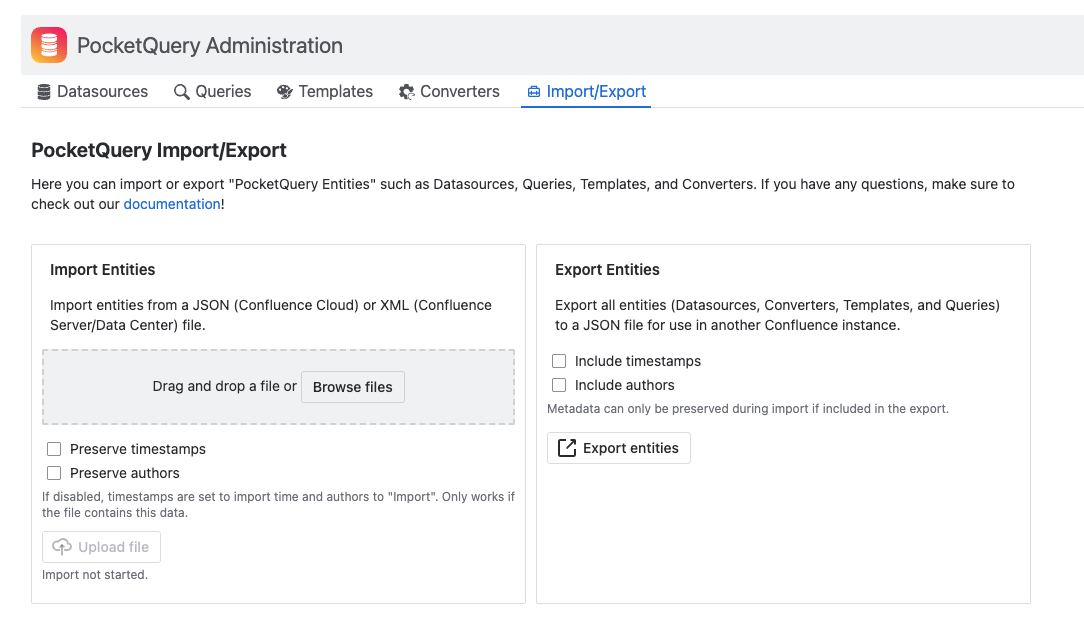
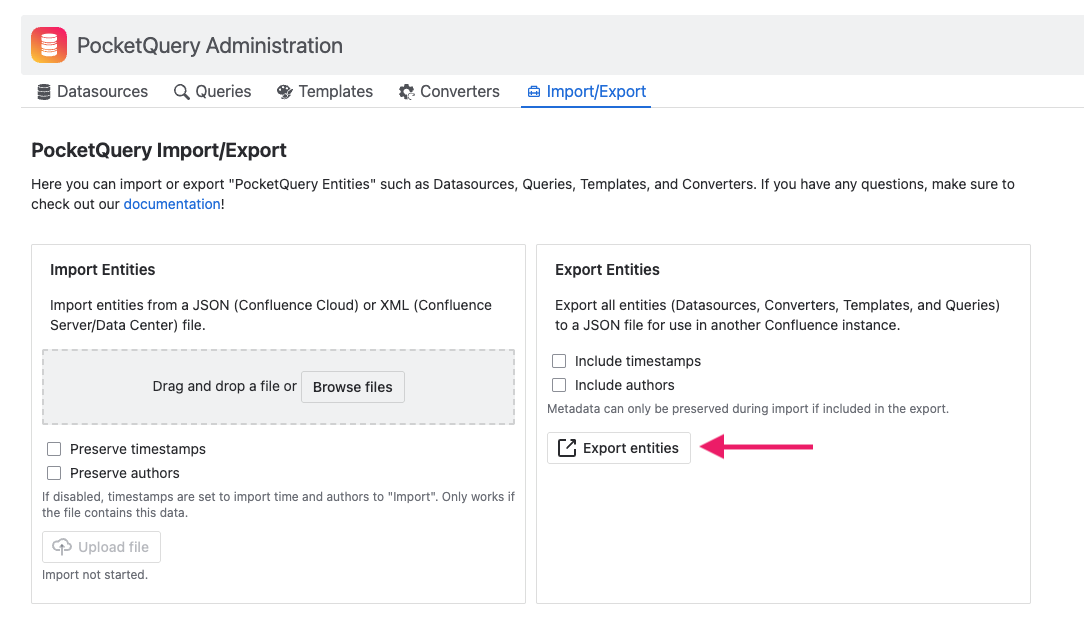
In this guide, we focus on the “Export” part, which you can find on the right. If you are looking for PocketQuery Import, refer to PocketQuery Cloud Import. To export your entities, all you need to do is clicking on the Export entities button:
The export process might take up to a minute based on your Confluence size. When the export is finished, you should see 2 buttons and a success message:
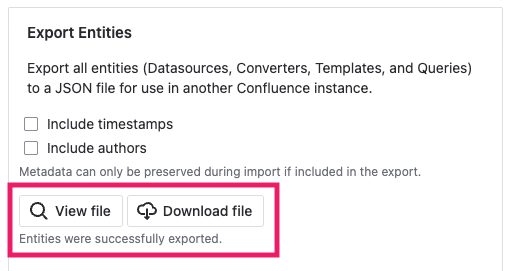
Now you can download your export or use our Export Viewer to browse the export in a human-readable format. The export file contains all your PocketQuery entities and their configuration, except Datasource credentials.
Warning: The export contains no Datasource credentials: no passwords, client secrets or tokens, and no request parameter or header values (their names are included). After importing into another Confluence instance, re-enter them in each Datasource. The same applies to copies created with Create copy.
Export metadata options
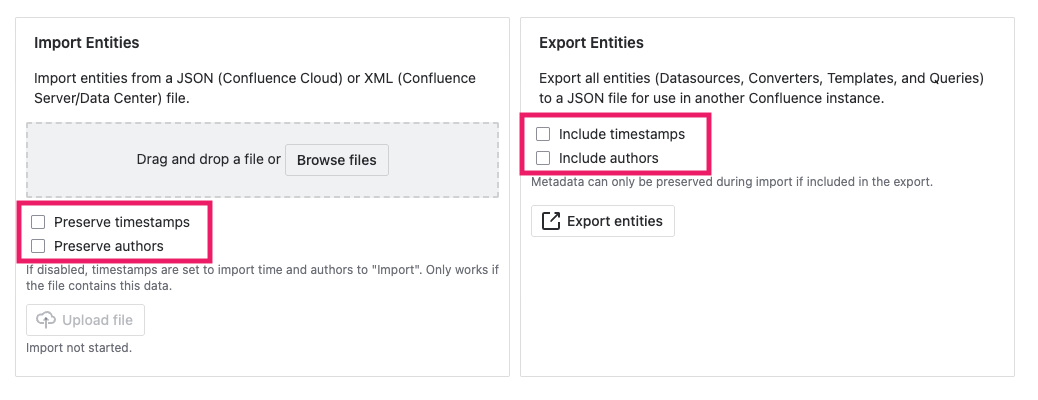
You can control whether user activity metadata (such as timestamps and user IDs indicating when an entity was created or updated, and by whom) is included in the export.
-
Include timestamps/authors enabled: export includes
createdBy,createdAt,updatedBy,updatedAt. -
Disabled: these fields are excluded from the exported file.
Use this option when you want to balance traceability vs. portability/privacy in migration files.
Download Exported Entities
You can download the exported entities by clicking the Download file button:
This will save the full export to your computer. The name of the file corresponds to the pattern pocketquery_export_{MONTH-DAY-YEAR}.json (for example pocketquery_export_06-24-2021.json). The export format is always JSON.
View Exported Entities
You can view the export result by clicking on the View file button:
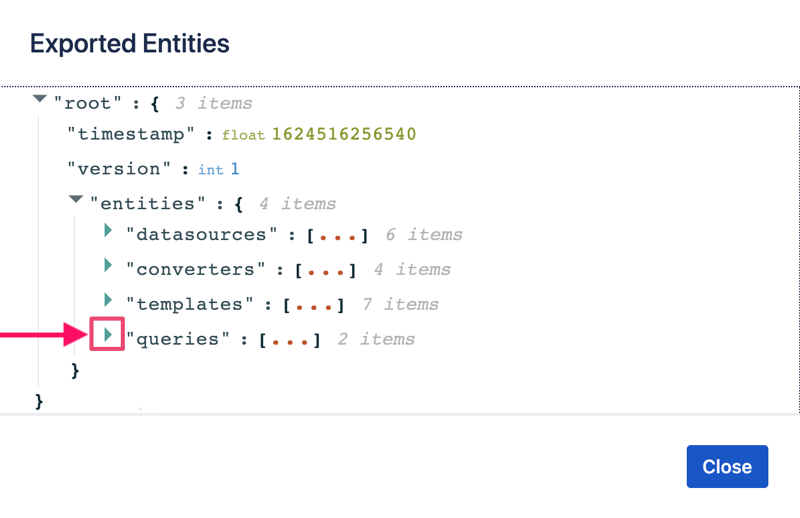
This option opens a dialog with the export preview. In the preview, you can see the full export structure, the entities object contains 4 attributes, each corresponds to one entity type (Databases, Queries, Converters, and Templates). Clicking on the rectangle icon on the left side of the attribute allows you to collapse/expand the object:
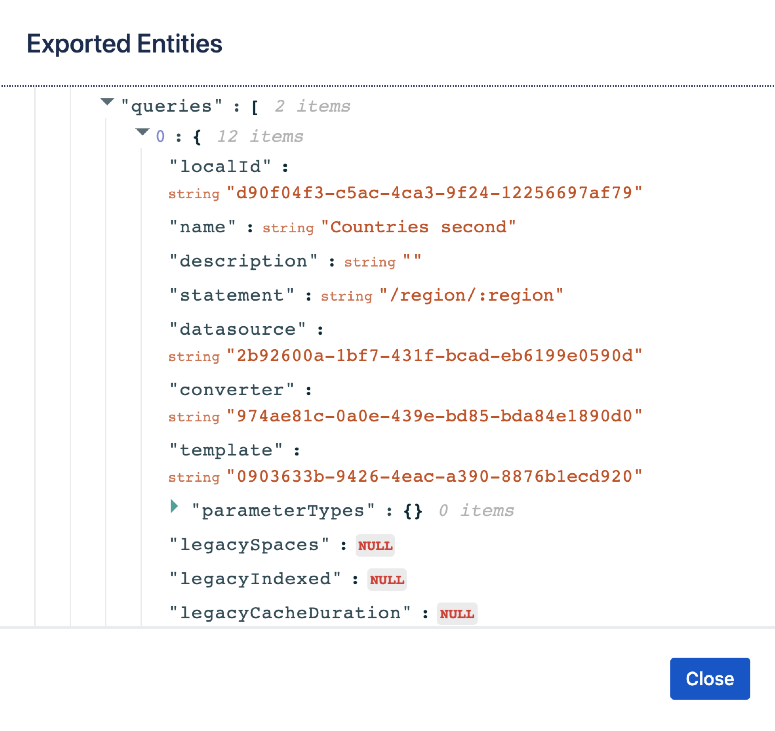
After expanding an entity, you can see the details about the entity. For example, a Query is represented as:
How can I utilize the PocketQuery Export?
You can export your entities at any time. This can serve as a backup or you can use it for a migration between two Confluence Cloud instances.
Keep in mind: a file containing Confluence Cloud entity export can be imported to any other Confluence Cloud instance but it is not backwards-compatible with Confluence Server or DC.